

Introduction
Long before the UAE became a hub of modern technology and innovation, its inhabitants were masters of a different kind of engineering—one born from the urgent need to survive in an arid landscape. The falaj (plural: aflaj) is a gravity-fed irrigation system that dates back over 3,000 years, a testament to the profound scientific understanding and ingenuity of the region’s ancient peoples. This sophisticated network of underground tunnels and surface channels did more than just transport water; it enabled the rise of settled agriculture, supported the growth of complex societies, and laid the hydrological foundation for the oasis cities that would dot the map of the UAE. The falaj is arguably the most significant scientific and engineering achievement of the region’s pre-oil era.
The Engineering Marvel: Anatomy of a Falaj System
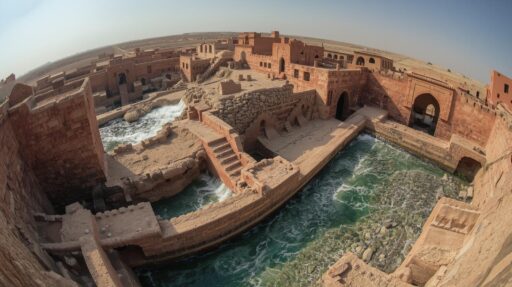
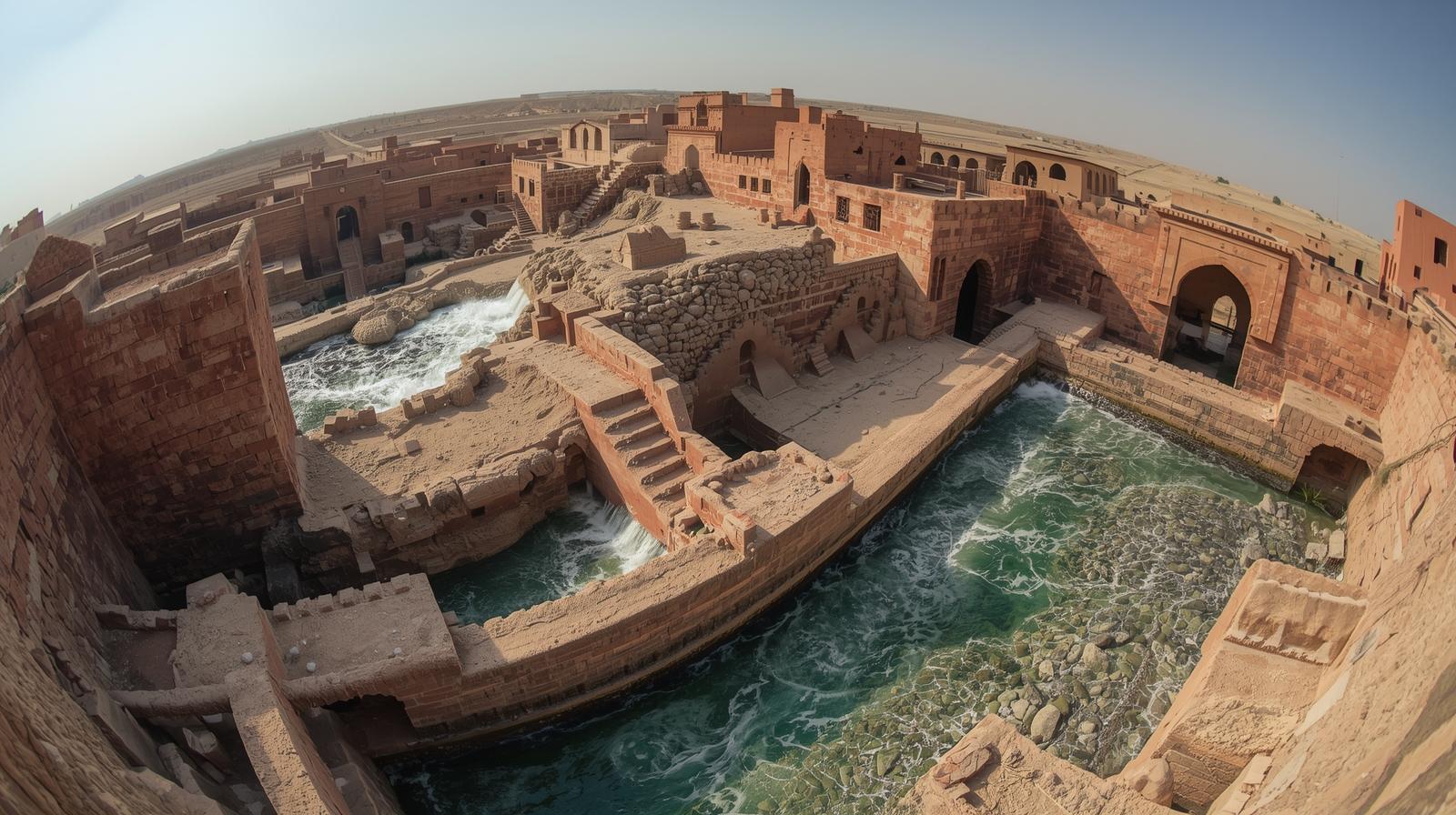
A falaj is a masterpiece of hydrological engineering. Its construction begins with a “mother well” (Umm Al Falaj), dug deep into an underground aquifer, often located at the base of a mountain range where water naturally percolates and collects. From this source, a gently sloping underground tunnel is meticulously dug, sometimes stretching for several kilometers, to channel water by gravity alone to the areas where it is needed for cultivation and daily life. At regular intervals, vertical access shafts (thuqboor) are dug down to the tunnel. These shafts served a dual purpose: they provided ventilation for the diggers and allowed for ongoing maintenance and clearing of silt and blockages. The water finally emerges at ground level into an open channel that distributes it through the oasis.
The Science of Slope and Surveying
The most remarkable aspect of the falaj is its precise gradient. The builders, without modern surveying tools, possessed an intuitive understanding of hydrology and topography. The tunnel had to have a consistent, gentle slope—steep enough to ensure a steady flow of water, but not so steep as to cause erosion or a torrent that would damage the channel. This was achieved through generations of accumulated knowledge, likely using simple but effective tools like sighting poles and water levels. This precise engineering ensured a reliable, year-round water supply, transforming patches of the desert into fertile, green oases capable of supporting date palm groves and other crops.
A Social and Legal Framework: The Management of Water
The science of the falaj was not limited to its construction; it extended to its management, creating one of the world’s earliest known systems of water law. The distribution of water was meticulously regulated and measured using time-based units. A designated water master, the arif al falaj, was responsible for allocating specific time slots to each farmer according to the size of their land and their established water rights. This was often measured with a sundial or a water clock (clepsydra). This equitable system, governed by community consensus and enforced by elders, prevented conflicts and ensured the sustainable use of the precious resource, demonstrating an advanced socio-scientific approach to resource management.
The Legacy of the Falaj in a Modern World
While modern desalination plants now provide most of the UAE’s water, the historical and cultural significance of the aflaj is immense. The Al Ain Oasis, a UNESCO World Heritage Site, is a living museum of this technology, where some channels still carry water to the palm groves. The UAE government has undertaken extensive conservation projects to restore these ancient systems, recognizing them as monuments to human ingenuity. The principles of the falaj—sustainable sourcing, efficient transport, and equitable distribution—are more relevant than ever in a world facing water scarcity. The falaj stands as a powerful reminder that the region’s legacy of innovation is not new, but is built upon a foundation of ancient, sustainable science.
Conclusion: The Foundation of Life and Knowledge
The falaj system is the unsung hero of Emirati civilization. It was the catalyst that enabled the transition from a nomadic, pastoral lifestyle to a settled, agricultural society. It represents a triumph of empirical science, where careful observation of the environment led to a technological solution that sustained life for millennia. The values it instilled—cooperation, fairness, and meticulous resource management—are deeply embedded in the Emirati character. In the gentle, continuous flow of water through the ancient tunnels of the falaj, one can hear the steady pulse of a civilization that learned not just to survive in the desert, but to master it through science, engineering, and collective wisdom.