

Introduction
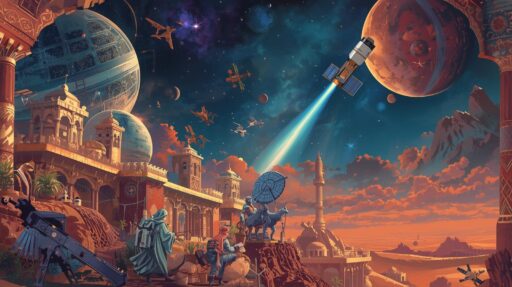
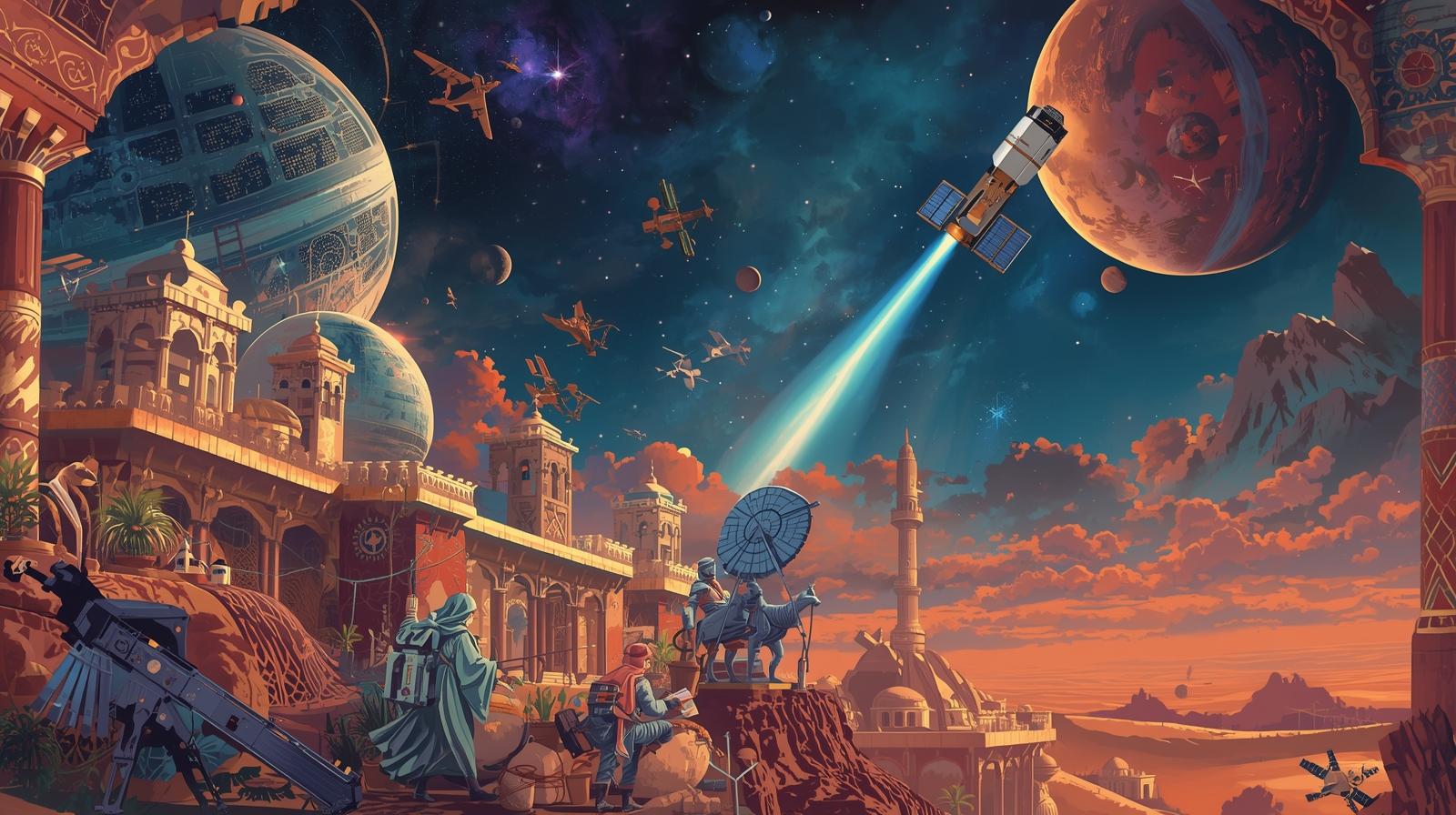
The story of the UAE’s relationship with the cosmos is one of dramatic acceleration. For centuries, the people of the Arabian desert were master celestial navigators, using the stars to guide their journeys across the trackless dunes. In the 21st century, this ancient fascination with the heavens has been catapulted into the space age, culminating in one of the most ambitious space missions of the modern era: the Emirates Mars Mission, known as the “Hope Probe.” This journey from reading the stars to orbiting Mars represents a fundamental pivot in the nation’s identity, showcasing a strategic leap from a resource-based to a knowledge-based economy.
The Bedouin Astronomers: The Original Navigators
Long before telescopes and GPS, the Bedouin of the Arabian Peninsula possessed a deep, practical knowledge of astronomy. The clear, unpolluted desert skies provided a perfect celestial map. They identified constellations, tracked the movements of planets, and used the stars to determine directions and the timing of seasonal migrations. The position of certain stars, like Suhail (Canopus), signaled changes in the weather and the arrival of cooler temperatures. This knowledge was not academic; it was essential for survival, for finding water sources, and for navigating the vastness of the Empty Quarter. This historical connection to the cosmos is the foundational layer of the UAE’s space story.
The Birth of a National Space Ambition
The modern UAE space program began not with a whimper, but with a bold, strategic vision. In 2006, the UAE government began investing in satellite technology, establishing the Emirates Institution for Advanced Science and Technology (EIAST), which later became the Mohammed bin Rashid Space Centre (MBRSC). The launch of DubaiSat-1 in 2009 and DubaiSat-2 in 2013 demonstrated the country’s commitment to developing indigenous satellite capabilities for earth observation, urban planning, and environmental monitoring. These early steps were crucial for building local engineering talent and proving that the UAE could compete in the high-tech arena of space.
The Hope Probe: A Nation’s “Moonshot” Moment
In 2014, His Highness Sheikh Khalifa bin Zayed Al Nahyan announced an audacious goal: to send an unmanned spacecraft to orbit Mars by 2021, coinciding with the 50th anniversary of the UAE’s founding. The Emirates Mars Mission “Hope Probe” (Al Amal) was born. The challenges were immense. The UAE had to achieve in six years what other nations had taken decades to do. To meet this deadline, the MBRSC entered into a knowledge-transfer partnership with American universities, but with a crucial stipulation: the spacecraft had to be built by Emirati engineers. This ensured the project would build long-term capacity, not just deliver a single mission.
Scientific Objectives and Global Collaboration
Launched in July 2020, the Hope Probe successfully entered Mars’ orbit in February 2021, making the UAE the fifth entity in history to reach the Red Planet. Unlike other missions focused on geology, Hope’s unique scientific objective was to study the Martian atmosphere. It aimed to create the first complete picture of the Martian climate throughout the Martian year, investigating how energy and particles move through the atmosphere and how atmospheric gases escape into space. The data it collects is shared freely with over 200 scientific institutions worldwide, positioning the UAE as a collaborative global contributor to human knowledge.
Conclusion: Inspiring a New Generation
The success of the Hope Probe is far more than a technological triumph; it is a powerful national project with profound socio-economic goals. It was designed to create a shockwave through the UAE’s education system, inspiring a generation of young Emiratis to pursue careers in STEM (Science, Technology, Engineering, and Mathematics). The mission has rebranded the nation from a consumer of technology to a producer of cutting-edge science. It proves that the same spirit that once used the stars to navigate the desert can now be harnessed to navigate the solar system, ensuring the UAE’s place not just as a regional leader, but as a rising star in the global scientific community.